Language #1 - Read in English
Language #2 - Czytaj po polsku
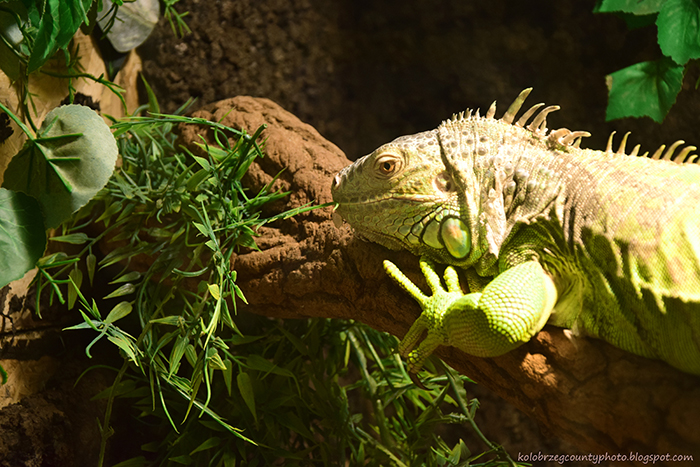
'Green Iguana ( Iguana iguana )The colour of the iguana's body resembles the green of young leaves and it owes its name to it. The colour, however, depends on the conditions in which the iguana is kept and changes with growing up. It also has transversal, dark stripes on the tail and trunk. On the back, there is an impressive and scary-looking comb with 'spikes', which are actually soft. Under the beard, there is a sycamore sack, which in the sense of danger, the iguana can inflate. Although the iguana has nostrils, it does not use them to recognize the odours, but to breathe and expel the salt (sometimes you can hear it when the iguana sneezes). The organs of a vision are obviously eyes, however, iguanas have an 'extra' eye, the so-called parietal organs. It is a lens, covered with a layer of skin and reacting only to light and shadow. It helps to identify threats from the head, such as birds of prey. Legs of iguana are equipped with sharp claws and jaws with small but sharp teeth serving both to tear the food and defend it. The muscular, long tail of the iguana also serves as a defence. With a tail, an adult animal can damage or even break an opponent's limbs when in danger. The iguana diet should be rich in fruits, vegetables, leaves, sprouts and flowers.' Aquarium, Kolobrzeg.


'Green Iguana ( Iguana iguana )The colour of the iguana's body resembles the green of young leaves and it owes its name to it. The colour, however, depends on the conditions in which the iguana is kept and changes with growing up. It also has transversal, dark stripes on the tail and trunk. On the back, there is an impressive and scary-looking comb with 'spikes', which are actually soft. Under the beard, there is a sycamore sack, which in the sense of danger, the iguana can inflate. Although the iguana has nostrils, it does not use them to recognize the odours, but to breathe and expel the salt (sometimes you can hear it when the iguana sneezes). The organs of a vision are obviously eyes, however, iguanas have an 'extra' eye, the so-called parietal organs. It is a lens, covered with a layer of skin and reacting only to light and shadow. It helps to identify threats from the head, such as birds of prey. Legs of iguana are equipped with sharp claws and jaws with small but sharp teeth serving both to tear the food and defend it. The muscular, long tail of the iguana also serves as a defence. With a tail, an adult animal can damage or even break an opponent's limbs when in danger. The iguana diet should be rich in fruits, vegetables, leaves, sprouts and flowers.' Aquarium, Kolobrzeg.


Linked to:


Location:
Oceanarium, Kołobrzeg, Polska
Iguana iguana
by
Klara S
on
Saturday, December 08, 2018
Language #1 - Read in English Language #2 - Czytaj po polsku 'Green Iguana ( Iguana...






 "
border-radius: 100%;
border-image-source: initial;
border-image-slice: initial;
border-image-width: initial;
border-image-outset: initial;
border-image-repeat: initial;
border-width: 1px;
border-style: solid;
border-color: rgb(235, 235, 235);
margin:0;
padding: 5px;
/" />
"
border-radius: 100%;
border-image-source: initial;
border-image-slice: initial;
border-image-width: initial;
border-image-outset: initial;
border-image-repeat: initial;
border-width: 1px;
border-style: solid;
border-color: rgb(235, 235, 235);
margin:0;
padding: 5px;
/" />


 Posts
Posts



